

Understanding the elements of bribery under Saudi law is the first step in knowing whether an incident legally amounts to bribery, or is simply a gift or courtesy that carries no criminal liability.
Many people confuse three separate questions: whether the person holds the status of a public official, what the prohibited act is (requesting, accepting or taking a benefit), and whether the criminal intent on which liability is built is present.
Are you facing a bribery accusation or investigation and unsure whether the elements of the offense apply to your situation? The Al Safwa team reviews the facts and initial documents, and explains your legal position and the appropriate next step clearly and calmly.
Request an Initial Review of a Bribery Accusation
Table of Contents
What Are the Elements of Bribery Under Saudi Law?
When we speak of the elements of bribery under Saudi law, we mean the components that must all be present together for an incident to be legally described as bribery, rather than a mere administrative violation or a passing gift.
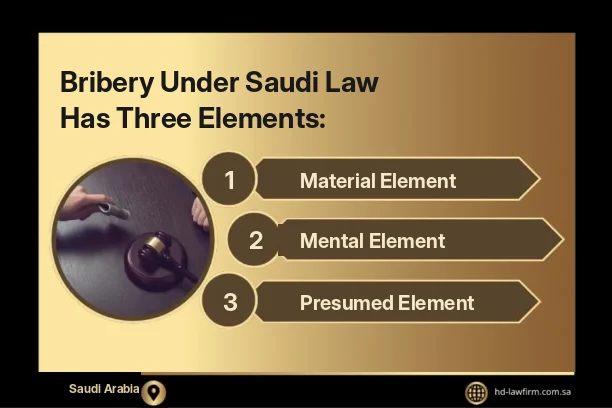
The three elements in brief:
- The presumed element (status): the offender must be a public official, or a person treated as a public official for the purposes of the Anti-Bribery Law.
- The material element (the act): a bribery act such as requesting, accepting or taking a promise, gift or benefit in exchange for performing an official duty, refraining from it, or breaching it. This applies even if the official only claims the task is within their authority, or if the task itself is lawful.
- The mental element (intent): criminal intent must exist, meaning the offender knows the nature of the benefit and that it is linked to exploiting the position or influencing the performance of official duties, and then chooses to accept it.
The Presumed Element: Who Is a Public Official or Treated as One?
The presumed element means the law does not look at the act alone. It also looks at the person’s status: is this someone the Anti-Bribery Law applies to, as a public official or a person treated as one?
Under the text of the law, this status is broad. It covers anyone working for the State or for bodies with public legal personality, whether permanently or temporarily, along with other categories the law specifies.
Practical Examples of Public Official Status in Bribery Cases
Common practical examples (for illustration, not an exhaustive list):
- An employee or contractor working for a government entity or a public body with legal personality.
- A person assigned a task or service connected to a decision, license or procedure on behalf of a public body.
- A person responsible for procedures that affect individuals’ interests (approvals, permits, completing transactions, and so on).
The Material Element: Which Acts Count as Bribery?
The material element is the bribery conduct that links a benefit to an official act or to influence over official duties. The Anti-Bribery Law criminalizes specific forms, most notably requesting, accepting or taking a promise, gift or benefit in exchange for performing an official duty (or claiming it is one), even if the act itself is lawful.
Common Forms of the Material Element: Requesting, Accepting, Taking, Offering, Mediating
In practice, bribery usually appears in these forms:
- Requesting: the official asks for a benefit, explicitly or by implication (money, a gift, a service or an advantage).
- Accepting or taking: accepting the promise or actually receiving the benefit.
- Offering or promising by the other party: offering a benefit to influence a procedure or decision.
- Mediation: an intermediary steps in to arrange, pass on or negotiate the benefit.
- The common thread: there is always something given in return that is linked to the position (speeding up a transaction, bypassing a procedure, changing a decision, overlooking a violation, and so on).
Is the Offense Committed Even If the Favor Is Never Carried Out?
Yes. The offense may be established even if the agreed act was never performed or the promised result never happened. In many cases, what matters is the presence of the prohibited conduct, its link to the position, and the intent, as shown by the facts and evidence.
The Mental Element: Criminal Intent and How the Prosecution Proves It
The mental element asks two questions. Did the offender know the benefit was not just an innocent social gift, but was linked to exploiting the position or influencing official duties? And did they choose to accept that link?
In practice, intent is rarely proven by a direct confession. It usually emerges from circumstantial evidence such as:
- The context of communications (correspondence, messages, recordings).
- The timing of the benefit compared with an official procedure or decision.
- Repeated requests, “pricing” a service, or an explicit link between the benefit and the procedure.
- Attempts to conceal the benefit or to pass it through an intermediary.
When Is Intent Absent? (Common Practical Situations)
Intent may be absent, or weakened, in fact-based situations such as:
- There is no link at all between the benefit and a specific official act (nothing in return and no influence).
- It is proven that the benefit never reached the official and was never offered to them, or that they refused it and reported it.
- There is a lawful, documented explanation for the benefit (for example, an independent contractual obligation unrelated to official duties), provided it is supported by documents and a clear context.
- The assessment here depends on documents and circumstantial evidence, not on impressions.
When Does a Gift or Courtesy Become Suspected Bribery?
Not every gift is a bribe. However, certain warning signs can turn a gift from a courtesy into a suspicion that needs careful legal assessment, most importantly:
- Sensitive timing: a gift given before, during or after an official procedure that directly affects the giver.
- Something clearly or implicitly expected in return: moving a transaction forward, overlooking a violation, or awarding a contract.
- Value or frequency: unusually expensive or repeated gifts.
- Method of delivery: through an intermediary, or as transfers or indirect benefits.
- An unbalanced relationship: a gift from someone with a direct interest to the official handling their procedure.
The practical rule: the closer a gift is to the point of an official decision, the more sensitive it becomes, and the more likely it is to be characterized as bribery depending on the facts.
How Is Bribery Proven? (The Most Common Evidence)
Proof of bribery is usually built on a chain of evidence and indications, such as:
- Correspondence, messages and chats (WhatsApp, email, and so on).
- Traceable financial transfers or benefits (invoices, bookings, purchases).
- Witness testimony or statements by the parties.
- Seizure and investigation reports and the related legal procedures.
- Digital evidence: the Saudi Law of Evidence recognizes the probative value of digital evidence, and a party who claims digital evidence is invalid bears the burden of proving it.
How Our Team Helps in Bribery Cases
At Al Safwa Law Firm, we handle bribery cases with a team approach focused on organization and clarity:
- Reviewing the facts and documents to determine whether the elements are present, and where the strengths and weaknesses lie.
- Analyzing seizure and investigation reports and the procedures used to gather evidence.
- Building a realistic legal strategy: a defense, or a grievance or objection, depending on the stage of the case.
- Drafting legal memoranda in precise language that connects the legal text to the facts without exaggeration.
- Following up on procedures and keeping the client clearly informed: what is needed now, what to expect next, and which documents are required.
Contact us to book a consultation, or send a summary of your facts on WhatsApp so we can review your legal options clearly. You can also learn more about our criminal defense services in Saudi Arabia.
Frequently Asked Questions
How can bribery be proven?
Bribery is proven by establishing its elements, using all means of proof recognized under the Saudi Law of Criminal Procedure and the Law of Evidence. These include written evidence, digital evidence, witness testimony, inspection, expert reports, questioning of the accused, and confession.
What is the penalty for bribery in Saudi Arabia?
Under the Saudi Anti-Bribery Law, the penalty is imprisonment for up to ten years and a fine of up to SAR 1,000,000, or either of these penalties. This applies to the briber, the bribe-taker and the intermediary between them.
What are examples of bribery?
Examples include paying an official to secure someone’s appointment to a job, a promotion to a position they do not deserve, an academic certificate, tax evasion, skipping the queue for public services, or obtaining an administrative decision or court ruling in the briber’s favor.
In this article, we explained the elements of bribery under Saudi law and the penalties that apply. Anyone facing a bribery case, whether as the alleged briber or the alleged recipient, should obtain specialized legal advice early. The criminal defense team at Al Safwa Law Firm and Legal Consultations can review your case and explain your options.
You may also be interested in our Labor Office lawyer services.
Sources:
- Anti-Bribery Law, issued by Royal Decree No. M/36 of 1412H, as amended.

A legal advisor holding a Bachelor’s degree in Law from the prestigious Cairo University. He possesses extensive experience spanning over 25 years in criminal, civil, and family law, during which he has achieved notable accomplishments that have solidified his reputation as a valuable asset to any legal team