

The question of the penalty for defamation and reputational harm in Saudi Arabia arises when something published insults a person or damages their reputation, especially when it happens on social media, through apps or on websites. How the incident is legally characterized depends on what was published, the means used, and the evidence proving the incident and attributing it to the person responsible.
The Anti-Cybercrime Law criminalizes defaming others and causing them harm through information technology means. For this reason, not every disagreement or criticism can simply be described as defamation. The content, the context, the means of publication and the evidence must be reviewed before the legal characterization and the appropriate next step can be determined.
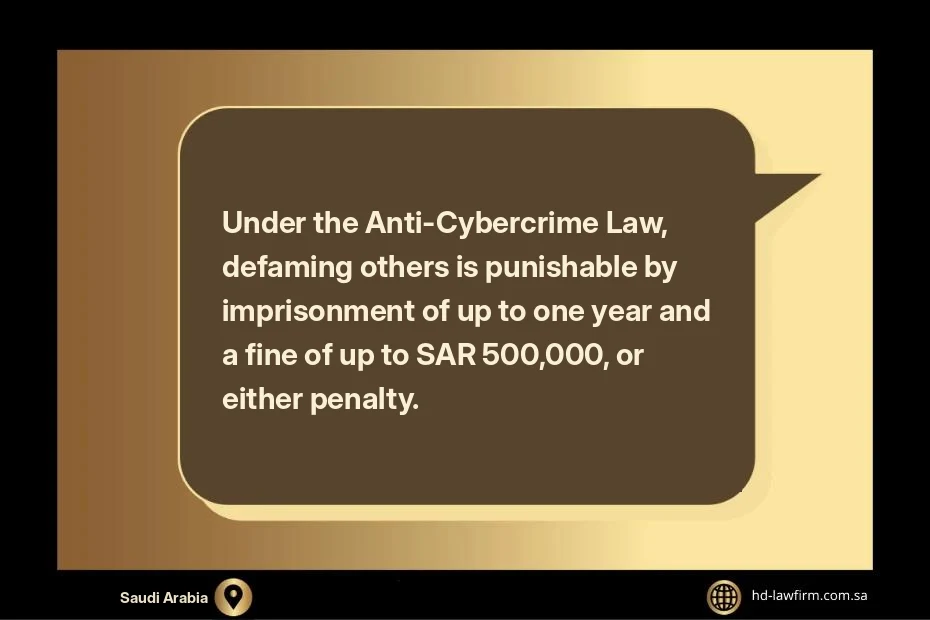
If the defamation and harm to another person are committed through information technology means, Article (3) of the Anti-Cybercrime Law may apply. It provides for imprisonment for a period not exceeding one year and a fine not exceeding SAR 500,000, or either of these two penalties. These are maximum limits, not a fixed penalty applied automatically to every incident.
Has something been published that harms your reputation, and do you want to understand your legal position?
The Al Safwa Law Firm team reviews the content and the available evidence, and explains your options and the appropriate next step based on the details of the incident.
Have Your Defamation Incident Assessed
Table of Contents
What Is Defamation, and When Is It a Crime in Saudi Arabia?
The Anti-Cybercrime Law does not set out a general definition covering every situation people might call “defamation”. It does, however, expressly criminalize defaming others and causing them harm through the various means of information technology.
The legal characterization of an incident therefore depends on the means of publication and the content. If the act was committed electronically, it may fall within the scope of the Anti-Cybercrime Law. If it was committed by other means, a different law or legal characterization may apply, depending on the details of the incident.
What Types of Defamation Cases Exist Under Saudi Law?
Incidents that people describe as defamation can take many forms, most notably:
- Online defamation: publishing content on social media, apps or websites in a way that may amount to defaming others and causing them harm through information technology means.
- Media publication: publishing content that harms a person’s reputation or dignity through a medium that falls within the scope of the Law of Printed Materials and Publication.
- Harm in the workplace: publishing statements or accusations that damage someone’s professional reputation. The characterization depends on the means, the content and the facts.
- Insult or slander: the incident may involve an insult or an accusation that needs to be distinguished from defamation. You can review the difference between insult and slander under Saudi law to understand this overlap.
- Publishing private information or images: this may overlap with other provisions, including those on invasion of privacy, depending on the means and the content.
What Is the Penalty for Defamation and Reputational Harm in Saudi Arabia?
The answer depends on how the incident was committed and how it is legally characterized. If the defamation and harm to others were committed through information technology means, Article (3) of the Anti-Cybercrime Law is the provision most clearly connected to this situation.
Article (3) provides for imprisonment for a period not exceeding one year and a fine not exceeding SAR 500,000, or either of these two penalties, for anyone who commits one of the offenses listed in the article, which include defaming others and causing them harm through information technology means.
Note that one year and SAR 500,000 represent the maximum penalty set out in the law; they are not a fixed penalty for every case. Nor is it correct to apply this penalty automatically to every insult or dispute that occurs outside information technology means, since the characterization varies according to the substance of the incident, the means used and the applicable provisions.
Penalty for Defamation on Social Media
Information technology means may include posts, tweets, comments, chats and other digital content, provided the elements of the incident to which the provision applies are present.
For this reason, you should save the link to the content and the account, the publication date, and any related messages or images before the content is deleted or you lose access to it. Liability is not assessed solely on the injured party’s description of the incident, but on what can be proven and attributed to the person responsible.
If the harm occurred outside information technology means, the penalty in Article (3) of the Anti-Cybercrime Law does not apply to it automatically. The means of publication, the substance of the incident, and the applicable law or legal characterization must first be determined.
Penalty for Damaging Someone’s Reputation at Work
Reputational harm can occur in the workplace through the spreading of accusations or statements that damage the reputation of an employee or an employer. There is no single penalty that applies to every incident simply because it took place at work; the characterization depends on the substance of the conduct, the means used and the resulting harm.
If the defamation was carried out by email, messaging apps or other information technology means, the incident may be examined under the Anti-Cybercrime Law where the conditions for its application are met. Other incidents require their nature and the relevant laws to be identified before liability or a penalty can be determined.
The Difference Between Defamation, Slander and Insult
The terms defamation, insult and slander do not carry the same meaning in every case. Insult (sabb) is usually associated with abuse or name-calling, while whether something is slander (qadhf) depends on the substance of the accusation itself, and it may be treated differently if it involves an explicit accusation of adultery or sexual immorality. Online defamation, on the other hand, concerns publishing content and harming another person through information technology means, where the conditions for applying the provision are met.
The three terms should therefore not be used interchangeably when describing a case. If the incident involves insults or offensive accusations, you can review our article on the difference between insult and slander under Saudi law to understand the practical distinction between them.
If the issue is accusing a person of adultery or sexual immorality, different rules apply, which we cover in detail in our article on the ruling on slandering chaste women (qadhf al-muhsanat) in Saudi Arabia.
The Private Right in Reputational Harm Cases
The private right (al-haqq al-khass) in reputational harm cases is the right of the person harmed by the offense to claim their private right in accordance with the statutory procedures.
Under the Law of Criminal Procedure, a complaint filed by the person harmed by the offense is treated as a claim of their private right unless they expressly state that they waive it.
The person harmed by the offense may also assert their private right during the investigation, and the investigator decides whether to accept the claim in accordance with the statutory procedures. When the case is heard by the court, the injured party may pursue their requests relating to their private right in accordance with the Law of Criminal Procedure.
This applies to online defamation incidents where the offense is established and the injured party has suffered harm that justifies claiming their private right.
Elements of the Crime of Online Defamation
Article (3) of the Anti-Cybercrime Law does not list the elements of online defamation under these detailed headings. When assessing an incident, it is therefore more accurate to look at a set of factors that help determine whether the provision applies. The most important are the published content, the technological means, the attribution of the content to its author, and the harm caused to the other person, together with the context and the intent revealed by the facts and evidence.
The Act and the Means of Publication in Online Defamation
The first step is to examine the content that was published or sent, the means used, and whether it is an information technology means, such as social media, apps, websites or other digital means.
It is also necessary to verify that the publication can be attributed to the accused person, the nature of the content, and how far it is linked to harming the other person. The mere existence of a disagreement or criticism is not, on its own, enough to conclude that the description of online defamation applies.
Intent and Context in a Defamation Incident
The context of the publication, the wording used, the circumstances surrounding the incident, and what the evidence reveals about the offender’s intent and the nature of their conduct are also considered.
For this reason, the legal characterization should not be determined from a single post or an isolated statement without reviewing the full content, the means, the parties and the evidence connected to the publication.
Describing the content as offensive is not, on its own, enough to decide the case. Proving the publication, attributing it to its author and establishing its context remain important factors in assessing the incident. If your main problem is a lack of evidence, see our article on filing a defamation case in Saudi Arabia and whether it can be accepted without evidence.
How Do You Prove an Online Defamation Incident?
Start by gathering whatever preserves the incident before the content is deleted or changed. The value of each piece of evidence may vary depending on its source, its integrity, and whether it can be attributed to the person the complaint is against.
Items that may help document the incident include:
- The link to the post, page or account.
- The account name and its visible details.
- Screenshots showing the content and its context.
- Related messages and chats.
- The date and time of publication, as far as possible.
- The original files, images or videos available.
- Any circumstantial evidence that helps show the content came from its source.
Not all of these items need to exist in every case. What matters is preserving whatever is available and not editing or cropping the content in a way that strips it of its context.
How Do You File an Online Defamation Complaint in Saudi Arabia?
Start by saving the content and the available evidence before taking any step, then record the details of the account or means used, the date of the incident and a brief description of what happened.
The Ministry of Interior provides an official service for reporting cybercrimes, which covers defamation or abuse via social media. The service explains that the reporting steps include selecting the cybercrime category and the sub-category, then adding a description of the incident and attachments, and submitting the report.
In practice, the steps can be arranged as follows:
- Save the available links, chats, images and digital evidence.
- Identify the account or means from which the content was published.
- Write a clear, brief description of the incident without exaggeration or unproven conclusions.
- Attach the available evidence when submitting the report.
- Follow up on whatever the competent authority requests, depending on how the matter proceeds.
- Assess the private right, or the need for an additional legal claim, depending on the harm caused.
Sample Complaint for Reputational Harm in Saudi Arabia
Note: The following sample is for guidance only and must be adapted to the incident, the competent authority, the evidence and the requests appropriate to each case.
To the Competent Authority
Complainant: [Name and required details]
Respondent: [Name, if known / available account or means details]
Subject: Complaint regarding an incident of defamation and harm to reputation through a technological means.
Facts of the complaint:
On [date], content was published/sent via [name of platform, app or means] from the account/number [available details]. The content included [a brief, accurate description of the statements or conduct complained of, without additions or exaggeration].
The available evidence relating to the incident has been preserved, including [links/images/chats/files/other data], and is attached to this complaint for review and for verification of the incident and its attribution to its source.
Requests:
I request that the incident be examined and that the necessary action be taken in accordance with the applicable laws and procedures, while reserving my private right and whatever follows from it as determined by the competent authority.
Attachments:
[List the attached evidence and documents]
Name: [Name]
Date: [Date]
Contact: [Mobile number or email]
This remains a general sample, because the wording of the facts and requests varies according to the type of defamation, the means, the evidence and the stage of the case. If you need the incident reviewed and the appropriate characterization determined before taking action, you can use Al Safwa Law Firm’s defamation lawyer service.
If you need more than a guidance sample, such as a statement of claim prepared specifically for your facts, evidence and requests, you can order the Drafting a Statement of Claim for Cybercrimes service from the Al Safwa store.
Why Is It Important to Work With a Lawyer Experienced in Defamation Cases?
You may need a legal review when it is difficult to determine whether the content amounts to defamation, insult or slander, when the digital evidence is incomplete, when the account is anonymous, or when the publication has caused professional or financial harm that needs to be documented.
A lawyer can review the substance of the post, the evidence and the stage of the case, and then explain the appropriate course of action and the scope of any possible claim, without assuming the outcome of the case before examining its details.
Frequently Asked Questions About the Defamation Penalty in Saudi Arabia
What is the penalty for online defamation in Saudi Arabia?
Article (3) of the Anti-Cybercrime Law provides for imprisonment for a period not exceeding one year and a fine not exceeding SAR 500,000, or either of these two penalties. The acts it covers include defaming others and causing them harm through information technology means.
Is SAR 500,000 a fixed fine in every defamation case?
No. SAR 500,000 is the maximum fine set out in Article (3); it is not a fixed amount applied automatically to every incident.
What is the difference between defamation and damaging someone's reputation?
"Damaging someone's reputation" is used as a general term for harming a person's reputation, whereas determining legal liability depends on identifying the act, the means and the substance of what was published. For incidents committed electronically, the Anti-Cybercrime Law expressly provides for defaming others and causing them harm through information technology means.
Can a defamation report be filed if the post has been deleted?
It may still be possible to assess the incident based on the evidence and circumstantial indications that were preserved, such as links, messages, images or account details. It is therefore advisable to save whatever digital evidence is available as early as possible.
Do I need to know who owns the account before filing a report?
The injured party may not know the identity of the account owner from the outset. What matters is keeping a record of the account, the content and the available details; the possibility of pursuing the incident is then assessed according to the evidence and the procedures of the competent authorities.
Can compensation be claimed for damage to reputation?
The injured party may have a private right if the incident caused harm that can be claimed and proven in accordance with the statutory procedures. The scope of the claim varies according to the circumstances of each case.
What is the penalty for defamation using photos in Saudi Arabia?
If photos are used through information technology means to defame and harm another person, the incident may fall under Article (3) of the Anti-Cybercrime Law where its conditions are met. Other legal characterizations may also apply depending on the nature of the photo and how it was obtained and published, so the incident must be assessed as a whole before the applicable provision and penalty are determined.
Defamation and reputational harm cases vary according to the substance of the publication, the means used, the evidence and the resulting harm. If the defamation and harm to another person were committed through information technology means, the incident may fall under Article (3) of the Anti-Cybercrime Law, which caps the penalty at one year’s imprisonment and a fine of SAR 500,000, or either penalty.
The practical first step is therefore to preserve the content and the evidence and to identify the source of the publication before taking action. The Al Safwa Law Firm team can review the incident and explain the appropriate legal options based on its details. Contact us.
Sources:
- Anti-Cybercrime Law – Bureau of Experts at the Council of Ministers.
- Law of Printed Materials and Publication – Bureau of Experts at the Council of Ministers.
- Law of Criminal Procedure – Bureau of Experts at the Council of Ministers.

A legal advisor holding a Bachelor’s degree in Law from the prestigious Cairo University. He possesses extensive experience spanning over 25 years in criminal, civil, and family law, during which he has achieved notable accomplishments that have solidified his reputation as a valuable asset to any legal team