
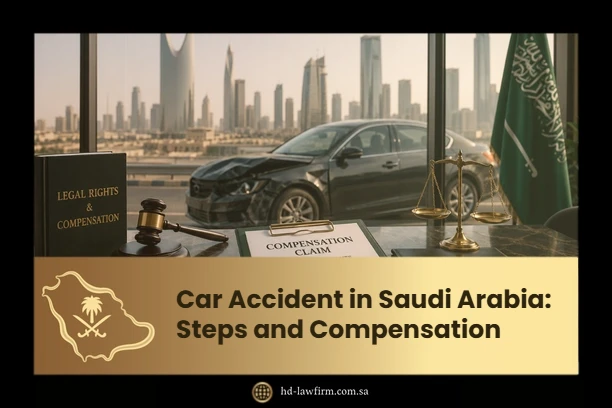
What should you do after a car accident in Saudi Arabia, and how do you claim compensation?
After a car accident in Saudi Arabia, make the scene safe, call emergency services if anyone is hurt, and have the accident documented by Najm or the Traffic Police (Muroor) before anyone leaves. That report sets each driver’s liability percentage, which decides who pays. Under the Unified Compulsory Motor Insurance Policy, the insurer must settle a complete third-party claim within 15 working days for individuals (45 for legal persons). If the claim is refused, or the accident caused injury or death, compensation, diya and arsh are decided by the competent committee or court.
You can book a consultation on WhatsApp with the team at Al-Safwa Law Firm for Advocacy and Legal Consultations to review your documents and explain your legal options clearly.
This guide covers the steps at the scene, how liability works, the official insurance deadlines and limits, what to do if the insurer refuses to pay, the difference between compensation, diya and arsh, and when a compensation case goes to court through Najiz. Facts are checked against official texts as of November 2026.
Table of Contents
What happens after a car accident in Saudi Arabia?
In short: the accident is recorded by Najm or Muroor, the report fixes each driver’s share of fault, and the at-fault driver’s compulsory insurer compensates the injured third party for vehicle damage, treatment costs and other proven losses, up to the policy limit. Disputes go to the insurance disputes committees or, for claims against a driver, to the general courts.
Steps to take at the scene
The first minutes matter most, both for safety and for the claim that follows. Follow these steps in order: The procedure after a car accident in Saudi Arabia usually starts with a traffic or Najm report, and the steps below follow that order.
- Check for injuries and call for help. If anyone is hurt, call the emergency services and the Red Crescent at once. Do not move an injured person unless there is an immediate danger.
- Make the scene safe. Switch on hazard lights and, if the cars can be moved and nobody is injured, move them out of traffic.
- Do not leave the scene. Leaving without an acceptable reason is a traffic offence, and the compulsory policy lists it among the cases in which the insurer is not liable to pay.
- Photograph everything. Take clear photos of both vehicles, plates, damage, road markings and signals from several angles.
- Exchange details. Note the other driver’s name, ID or Iqama number, plate number and insurer.
- Report the accident. Report it to Najm (through its app or official channels) or to Muroor, depending on the accident type and location.
- Avoid informal deals. Do not sign papers you do not understand, admit liability you do not owe, or accept a cash settlement before an official report exists.
Najm or Muroor: who documents the accident?
Najm for Insurance Services handles accidents involving insured vehicles, sends an investigator or reviews the accident remotely, and issues the accident report used for the insurance claim. Its official app lets drivers report an accident, upload photos, track the investigator and check the report status. Accidents with injuries or deaths, and cases outside Najm’s scope, are handled by the Traffic Police (Muroor).
| Situation | Who usually documents it | What you receive |
|---|---|---|
| Damage only, vehicles insured | Najm (app or investigator) | Najm accident report with liability percentages |
| Injury or death | Traffic Police (Muroor), with emergency services | Official traffic accident report |
| Uninsured vehicle or a case Najm does not cover | Traffic Police (Muroor) | Official traffic accident report |
How liability percentages work
The accident report states each driver’s share of fault as a percentage, for example 100% on one driver or a split such as 50/50. Insurers rely on this percentage when deciding who pays and how much.
Shared fault does not cancel your claim. Under Article 128 of the Civil Transactions Law (Royal Decree No. M/191), compensation is reduced, wholly or partly, in proportion to the injured person’s own contribution to the harm. So a driver who is 25% at fault can still claim, but the amount reflects that share.
If you believe the percentage is wrong, raise an objection quickly through the channel of the body that issued the report, and keep your photos and witness details ready. Insurers generally act on the report as it stands until it is changed.
Types of compensation after a car accident in Saudi Arabia
A car accident in Saudi Arabia does not give an automatic right to every type of compensation. Each head of claim needs documents that prove the harm, link it to the accident and show the liability share. Article 136 of the Civil Transactions Law requires compensation to cover the harm in full, and Article 137 measures it by the actual loss and lost profit that naturally result from the harmful act.
| Type of compensation | When it is claimed | Main proof |
|---|---|---|
| Vehicle damage | The car is damaged or loses value because of the accident | Accident report and damage assessment report |
| Bodily injury | Treatment, surgery or rehabilitation is needed | Medical reports and invoices |
| Temporary or permanent disability | The injury limits work or daily life for a period or permanently | Medical report stating the disability rate |
| Moral damage | Physical or psychological suffering linked to the accident | Facts of the accident, its effects and the decision of the competent authority |
| Diya or arsh | Death, or bodily harm that needs a Sharia or judicial assessment | Medical report, accident report and the competent authority’s decision |
Vehicle damage
This covers repair costs, spare parts and labour, and in some serious cases the loss in the car’s value. Keep the accident report, the damage assessment report, the vehicle and owner details, and your IBAN for payment. Vehicle damage valuation is regulated by the Saudi Authority for Accredited Valuers (Taqeem), whose website lists the Taqdeer system for estimating vehicle damage.
Bodily injury and disability
Injury claims can include treatment, tests, surgery, rehabilitation and the effects of temporary or permanent disability. There is no fixed figure for disability. The assessment depends on the type of injury, the disability rate, the person’s age, the effect on work and life, the fault share and the final medical report. For this reason, it is wise to wait for the final medical report before accepting an insurer’s offer.
Moral damage
Article 138 of the Civil Transactions Law states that compensation for a harmful act includes moral harm, meaning physical or psychological harm to a person from an infringement on their body, freedom, honour, reputation or social standing. A moral damage claim needs specific facts and evidence; general statements of distress are rarely enough.
How to claim compensation from the insurance company
The claim normally goes to the compulsory insurer of the driver who caused the accident. The insurer relies on the official report, not on either driver’s account, and then on the damage assessment or medical reports.
Claim steps
- Get the accident report and liability percentage from Najm or Muroor.
- Have the vehicle damage assessed by an accredited assessor before any repair.
- Collect medical reports and invoices if anyone was injured.
- Submit the claim through the insurer’s official channels with all documents.
- Follow the insurer’s acceptance or refusal decision.
- If refused, ask for the reasons in writing and copies of the supporting documents.
- Escalate to the Insurance Authority or the disputes committees if the refusal or delay has no legal basis.
Documents by type of claim
| Claim | Key documents |
|---|---|
| Vehicle damage | Accident report, damage assessment report, vehicle details, ID or Iqama, IBAN |
| Bodily injury | Accident report, medical report, treatment invoices, injured person’s ID, other documents as the case requires |
| Death | Accident report, death certificate, heirs’ documents, guardianship deed for minors if any, and what the competent authority requests |
| Refused claim | Refusal letter, insurance policy, accident report, all documents already given to the insurer |
If repairs were already done, the policy requires the actual repair invoices and an authorised damage assessment report prepared before the repair. Repairing first and assessing later is a common reason for disputes.
Official insurer deadlines and limits
The figures below come from the Unified Compulsory Motor Insurance Policy, updated version applied from 1 April 2023 (insurance supervision now sits with the Insurance Authority). They are current as of November 2026 and may change; check the official text before relying on them.
| Stage | Individuals | Legal persons (companies) | Policy reference |
|---|---|---|---|
| Acknowledge the claim and list missing documents | 3 working days | 9 working days | Article 7(1) |
| Notify acceptance or refusal | 5 working days from receiving the required documents | Article 7(3) | |
| Settle the claim (repair or payment to IBAN) | 15 working days | 45 working days | Article 7(2) and 7(4) |
| Maximum insurer liability per accident | SAR 10,000,000 in total for bodily injury, property damage and expenses | Article 4 | |
| Treatment costs at Ministry of Health facilities | Up to SAR 10,000 | Appendix A | |
If the insurer misses the deadline without a legal reason, Article 7(6) allows the claimant to complain or go to the disputes committees, and to claim compensation for loss of use of the vehicle caused by the delay.
If the insurer refuses or underpays the claim
A refusal, full or partial, is not the end of the claim. When the insurer refuses, Article 7(7) of the policy requires it to give the reasons, inform you of your right to complain or refer the dispute to the Committees for Resolution of Insurance Disputes and Violations, and give you copies of the documents it relied on if you ask.
- Ask for the refusal letter and reasons in writing.
- Read the policy and its exceptions.
- Check that your documents are complete.
- Review the accident report and the liability percentage.
- Compare the offered amount with the assessment report and invoices.
- File a complaint or a case if the refusal has no legal basis.
The Insurance Authority’s complaint service lets the insured or any party to the insurance relationship file a complaint online through the iCare portal; the service page (checked November 2026) lists it as free. If the dispute continues, it can go to the insurance disputes committees. Under their rules of procedure, a primary committee’s decision can be appealed within 30 days, and the appellate committee’s decision is final. Our insurance lawyer page explains how these disputes are prepared.
Common reasons claims are refused or delayed
- Incomplete file: a missing medical report, assessment report or IBAN stops the settlement clock from starting.
- Repairs before assessment: the insurer disputes the cost because no authorised assessment was made before the repair.
- Liability dispute: the claimant’s account differs from the report, and no objection was filed.
- A policy exception applies: for example drifting, racing, driving under the influence, leaving the scene without an acceptable reason, or a deliberate accident.
- Damage not linked to the accident: old damage or injuries not shown in the report or medical file.
Recourse: when the insurer pays and then claims from the driver
The policy separates the victim’s right to be paid from the insurer’s right to recover what it paid. In recourse cases, the insurer compensates the third party and then recovers the amount from the insured or the driver. Under Article 5 of the 2023 policy, these include:
- Driving against the direction of traffic.
- Running a red light.
- Using the vehicle against the restrictions in the policy schedule.
- Carrying more passengers than the seating capacity, where this caused the accident.
- Driving without the right licence class, with a forfeited licence, or with a licence expired and not renewed within the period the policy sets.
- A stolen or forcibly taken vehicle (recovery from the person responsible, and from the insured if the theft was not reported without an acceptable excuse).
The insurer must notify the insured or driver within 20 working days of the claim and may exercise recourse within one year of settling it. Separately, Article 6 lists exceptions where the insurer is not liable at all, including drifting, racing, driving under the influence, leaving the scene without an acceptable reason and deliberate accidents. In those cases the person responsible may face the compensation claim personally.
Compensation, diya and arsh: what is the difference?
These terms can appear in the same car accident case, but they are not the same thing. Article 142 of the Civil Transactions Law provides that where a harmful act causes death or bodily harm, compensation is determined under the Sharia rules on liability for crimes against life and body. This is where diya and arsh come in.
| Point | Compensation | Diya | Arsh |
|---|---|---|---|
| Meaning | Making good material, bodily or moral harm | An amount tied to specific cases, such as loss of life or harm with a set Sharia measure | An assessment for an injury or bodily harm that has no amount set in advance |
| What it covers | Vehicle damage, treatment, losses, moral harm | Death, or what falls under the rules of diya | Injuries, wounds and disability rates, as assessed |
| How it is proven | Invoices, reports, assessments, documents | Sharia, medical and judicial documents | Medical reports and the competent authority’s assessment |
| Fixed amount? | No, it depends on the harm | Its application depends on the case and the competent authority’s decision | Usually needs an assessment |
There is no single figure that fits every accident. Any answer that names a fixed amount without reviewing the accident report, the medical reports and the policy is not reliable.
Claims after a fatal accident
Death cases involve the heirs’ rights, the diya, other compensation linked to the accident, and the scope of the insurer’s or the responsible person’s liability. The file usually needs the accident report, death certificate, inheritance determination, guardianship deed for minor heirs if any, relevant medical or criminal reports, the insurance policy and any related judgments. Where minors or several heirs are involved, an inheritance lawyer can help organise the heirs’ documents. Shared fault, several parties or a dispute with the insurer over cover are further reasons to have the case studied on its own facts.
Filing a car accident compensation case on Najiz
A lawsuit is not the first step after every accident. It becomes necessary when the insurance claim fails, the refusal has no legal basis, the accident caused injury or death, or there is a serious dispute over liability or the amount.
The right forum depends on the claim. Disputes arising from the insurance policy go to the insurance disputes committees. Claims that go beyond the policy, such as a claim against an uninsured driver or for amounts above the cover, fall under Article 31(c) of the Law of Civil Procedure, which gives the general courts jurisdiction over lawsuits resulting from traffic accidents and Traffic Law offences. These are filed electronically through the Ministry of Justice’s statement of claim service on Najiz.
- Identify the claim: insurance, civil liability, injury, death or vehicle damage.
- Gather the accident report, assessment, medical reports, invoices and any refusal letter.
- Identify the defendant: the insurer, the person who caused the accident, or more than one party.
- Draft the statement of claim with clear facts and specific requests.
- Attach the supporting documents.
- File through the competent channel and follow the hearings, replies and requests.
A clear statement of claim saves time at the first hearing; see our statement of claim drafting service for what a complete claim includes.
Time limits you should not miss
| Claim | Time limit | Source |
|---|---|---|
| Disputes under the compulsory motor policy | Not heard after five years from the incident, unless the committees accept the reason for the delay | Policy, Article 9(8)(b); committees’ rules, Article 11 |
| Civil claim for a harmful act | Not heard after three years from knowing the harm and the person liable, and in all cases after ten years from the harm | Civil Transactions Law, Article 143(1) |
| Civil claim arising from a crime | Can be heard as long as the criminal case can still be heard | Civil Transactions Law, Article 143(2) |
Even with these limits, waiting is risky. Evidence fades, and injury or death cases need early documentation.
What is the punishment for causing a car accident in Saudi Arabia?
A serious car accident in Saudi Arabia can create two separate tracks. The private right belongs to the victim or heirs: compensation, diya or arsh. The public right belongs to the state: penalties under the Traffic Law (Royal Decree No. M/85 dated 26/10/1428H) and its amendments for accidents that cause death or injury, which can include imprisonment and fines decided by the court, besides traffic violations recorded by Muroor.
Waiving the private right, for example after a settlement with the family, does not by itself end the public right. Where an accident leads to a criminal case, a criminal lawyer in Jeddah can explain the procedure and the defence options.
Notes for expats and foreign company fleets
- Your Iqama and licence must be valid. An expired or wrong-class licence is a recourse case, so the insurer may pay the victim and then claim from you.
- Rental and company cars: report the accident officially first, then notify the rental company or fleet manager as the contract requires.
- Medical reports from abroad may need a certified Arabic translation before they are accepted.
- Leaving the Kingdom with an open claim: appoint someone under a power of attorney to follow it, so deadlines are not missed.
- Unpaid judgments are enforced through the Enforcement Court, which can take measures against the debtor; an enforcement court lawyer can help on either side.
For context, the Ministry of Health’s traffic accident statistics record 4,618 road traffic deaths and 25,561 injuries in 2020, the latest year on that page.
Do you need a lawyer after a car accident?
Not always. If the accident is minor, fault is clear, the documents are complete and the insurer pays a fair amount within the official period, the claim can be handled directly.
Legal help matters more when there is bodily injury, disability or death, the insurer refuses or underpays, the liability percentage is disputed, several parties are involved, a recourse case or exception is raised, or a lawsuit is needed. A lawyer reviews the report and the policy, identifies the competent forum, drafts the claim and follows the objection or case. No lawyer can promise an outcome; the final amount depends on the documents and the decision of the competent authority.
Frequently Asked Questions about car accidents in Saudi Arabia
Handling a car accident in Saudi Arabia well comes down to three things: an official report, a complete file and the right forum. The report sets liability, the documents prove the harm, and the policy, the Civil Transactions Law and the courts decide what is paid if the insurer does not settle.
If your claim was refused, the offer does not match the harm, or the accident caused injury or death, have the file reviewed before you accept a settlement or escalate.
To get a legal consultation from our team, contact us via the WhatsApp button at the bottom of the screen.
Read also:
Sources:
- Unified Compulsory Motor Insurance Policy, updated version (SAMA Rulebook), checked November 2026.
- Circular on applying the updated Unified Compulsory Motor Insurance Policy from 1 April 2023 (Insurance Authority).
- Insurance Authority: Complaint against an insurance company, checked November 2026.
- Rules and procedures of the Committees for Resolution of Insurance Disputes and Violations (Ministry of Finance).
- Civil Transactions Law, Royal Decree No. M/191 (English translation, MISA).
- Law of Civil Procedure, Royal Decree No. M/1 dated 22/1/1435H (Ministry of Justice).
- Ministry of Justice: statement of claim e-service (Najiz).
- Traffic Law, Royal Decree No. M/85 dated 26/10/1428H, and its amendments (Bureau of Experts at the Council of Ministers).
- Najm for Insurance Services: report an accident.
- Saudi Authority for Accredited Valuers (Taqeem).
- Ministry of Health: traffic accident statistics.
A legal advisor holding a Bachelor’s degree in Law from the prestigious Cairo University. He possesses extensive experience spanning over 25 years in criminal, civil, and family law, during which he has achieved notable accomplishments that have solidified his reputation as a valuable asset to any legal team