
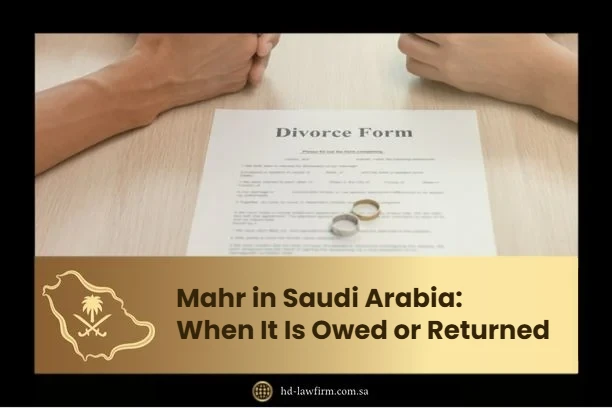
Mahr in Saudi Arabia: if the wife asks for divorce, does she have to return it?
Mahr in Saudi Arabia is the money or property a husband pays his wife because of the marriage contract, and under the Personal Status Law it belongs to her alone. Whether she must return it depends on how the marriage ends. If the husband divorces her after consummation, she keeps the full mahr. In khula she normally gives back what she received, and in a dissolution for proven harm the law does not require her to return it. The rules below follow the law as it stands in November 2026 and are part of our Saudi family law guides.
You can book a consultation on WhatsApp with the team at Al-Safwa Law Firm for Advocacy and Legal Consultations to review your documents and explain your legal options clearly.
Table of Contents
What is mahr under Saudi law?
Under Article 36 of the Saudi Personal Status Law, mahr is the property a man pays a woman because of the marriage contract. Anything that may lawfully be treated as property can be mahr (Article 37), such as cash, gold, jewellery or real estate. It is the wife’s own property, and she cannot be forced to dispose of it (Article 38).
The Ministry of Justice’s English e-services call it the “dowry”, and the dowry is one of the fields filled in when a marriage contract is created on Najiz (MOJ: Create marriage contract). The law was issued by Royal Decree No. M/73 dated 6/8/1443H, and its full Arabic text is published by the Bureau of Experts at the Council of Ministers (BOE: Personal Status Law).
When the mahr becomes due in full
Article 40 sets three steps. The mahr becomes owed by the valid marriage contract itself. It becomes confirmed in full by consummation, by valid seclusion (khalwa, defined in Article 7 as the spouses being alone in a place with no one of discerning age present) or by the death of either spouse. If the husband divorces before consummation, the wife is entitled to half of the named mahr. If no mahr was named, she receives a compensation gift (mut’a) of no more than half of the customary mahr.
Prompt and deferred mahr
Article 39 allows the couple to defer all or part of the mahr in the contract. Couples often split it into a prompt part paid at the wedding (muqaddam or mu’ajjal) and a deferred part (mu’akhkhar). The law fixes when each part falls due:
| What the contract says | When the mahr is payable | Legal basis |
|---|---|---|
| Nothing about deferral | Payable on demand | Article 39(2) |
| Deferred to a known date | On that date | Article 39(3)(a) |
| Deferred to an unknown or vague date | Treated as prompt (payable now) | Article 39(3)(b) |
| Deferred with no date at all | On final (irrevocable) separation or the death of either spouse | Article 39(3)(c) |
The wife may refuse consummation and refuse to move to the marital home until she receives the prompt mahr and the husband prepares a suitable home, and she keeps her right to maintenance during that time (Article 43). If she agrees to consummation before receiving it, the prompt mahr stays a debt she may claim at any time.
Customary mahr (mahr al-mithl)
Article 41 gives the wife the customary mahr in three cases: none was named, the contract stated that there is none, or the named one is invalid. Article 18 of the Implementing Regulations says the customary mahr is assessed by the mahr of comparable women among her relatives on her father’s and mother’s side. This is the only “calculation” the law provides, and it is done by the court when the parties disagree.
If the wife asks for divorce, does she return the mahr?
The answer depends on the route she takes. Under Article 77, talaq is the dissolution of the marriage by the husband’s will, and he may appoint an agent to pronounce it (Article 84). So a wife’s request ends the marriage through a divorce the husband agrees to give, through khula, or through a court dissolution (faskh). Each route has a different effect on the mahr.
| How the marriage ends | Effect on the mahr | Legal basis |
|---|---|---|
| Husband divorces her after consummation or khalwa | She keeps the full mahr, and the deferred part falls due on final separation | Articles 39 and 40 |
| Husband divorces her before consummation (mahr named) | She is entitled to half of the named mahr | Article 40(3) |
| Khula by agreement, with the mahr as compensation | She returns only what she received; the unpaid rest, including deferred mahr, is cancelled | Article 101 |
| Court dissolution at her request before consummation, husband refuses divorce or khula | She returns what she received | Article 112(1) |
| Dissolution before consummation for a reason on her side | She returns the mahr, plus what the husband spent on the marriage at her request, if he asks | Article 112(2) |
| Dissolution at her request because she fears not fulfilling marital duties, husband refuses divorce or khula | She returns what she received | Implementing Regulations, Article 28 |
| Dissolution for proven harm by the husband | The law does not make it conditional on returning anything | Article 108 |
| Separation through arbitrators | From no compensation to the full received mahr, depending on who caused the discord | Article 111 and Regulations, Article 30 |
Return of mahr in khula
Khula is a separation at the wife’s request with the husband’s agreement, in return for compensation paid by the wife or by someone else (Article 95). It is valid by mutual consent without a court judgment (Article 96), and there is no khula without compensation (Article 99). Khula counts as a dissolution, a minor final separation, and is not counted among the three divorces (Article 97).
The compensation does not have to be the mahr. Anything that can lawfully be property can be the compensation, but it can never be a waiver of the children’s rights or of their custody (Article 100). In practice the couple may agree on:
- the full mahr she received
- part of the mahr
- a different amount, lower or higher
- giving up the deferred mahr only, without returning the prompt part
Article 101 adds an important limit. If the khula compensation is “the mahr”, she hands back only what she actually received, and whatever remains unpaid falls away, even if it was deferred. So a wife whose husband never paid the deferred part does not pay it to him in khula; she simply loses the claim to it.
Khula must be documented by the spouses or one of them (Article 102). The Ministry of Justice offers a “Notarize Khul’” e-service on Najiz in the Social Affairs package (MOJ: Notarize Khul’). For help with the request or the negotiation, see our khula lawyer in Jeddah page.
Faskh (judicial dissolution) and the mahr
Every separation ordered by a court is a dissolution (faskh), a minor final separation that is not counted among the three divorces (Article 103). Its effect on the mahr depends on the reason and the timing.
Dissolution for harm
The court dissolves the marriage at the wife’s request when the husband harms her in a way that makes a decent married life impossible and the harm is proven (Article 108). Unlike Article 112 and Regulation Article 28, Article 108 does not make this dissolution conditional on returning the mahr, so the law does not require her to give it back. Regulation Article 27 accepts widespread testimony based on what is well known in the spouses’ circle as one way to prove harm. A wife may also seek dissolution for non-payment of maintenance (Article 107); see our marriage annulment lawyer page for dissolution cases.
Discord without proven harm: arbitrators
If harm is not proven but the discord continues and reconciliation fails, each spouse chooses an arbitrator from their family, or the court appoints them, for a period of no more than 60 days (Article 109). If they cannot reconcile the couple, the arbitrators decide on separation with or without compensation, and the compensation the wife pays may never exceed the mahr (Article 111). Regulation Article 30 tells them which outcome to recommend:
| Who caused the discord | Recommended outcome |
|---|---|
| All causes from the husband | Separation without compensation |
| All causes from the wife | Separation for the full mahr she received |
| Both spouses | Compensation in proportion to each one’s share of the discord |
| Cause unknown | Separation for half of the mahr |
In every case the arbitrators consider how long the marriage lasted. Under Regulation Article 31 the court may adopt the arbitrators’ opinion or dissolve the marriage and decide the compensation itself. It does not dissolve the marriage on compensation the wife received except with her consent.
Dissolution for a defect
Either spouse may ask for dissolution because of a harmful or repellent defect in the other that prevents married life (Article 104). Article 105 then fixes the mahr:
- Defect arising in either spouse after consummation: the husband cannot recover the mahr he paid.
- Defect in either spouse existing before the contract, dissolution before consummation or khalwa: the husband recovers what he paid, and the rest is cancelled even if deferred.
- Defect in the husband existing before the contract, dissolution after consummation or khalwa: the wife keeps the mahr.
- Defect in the wife existing before the contract, dissolution after consummation or khalwa: the wife keeps the mahr, and the husband may claim it back from whoever deceived him.
Unpaid prompt mahr
If the marriage has not been consummated and the husband does not pay the prompt mahr, the court gives him a deadline of no more than 30 days from the request and then dissolves the marriage at the wife’s request (Article 106). After consummation the marriage is not dissolved for non-payment; the mahr stays a debt and the court orders payment of the prompt part when she claims it.
Mahr before the marriage contract
Money handed over during the engagement is a gift, unless the suitor stated it was mahr or custom treats it as mahr (Article 3). If either party breaks off the engagement or dies before the contract, the suitor or his heirs may take back what he paid as mahr, or its equivalent or value on the day it was received (Article 5(1)). If the fiancée already bought items for the marriage with that money, and the suitor withdrew without cause from her, or she withdrew because of him, she may choose between returning the mahr and handing over what she bought (Article 5(2)).
How to document and claim the mahr
Under Article 17 of the Implementing Regulations, the mahr written in the contract is treated as the named mahr, unless both spouses confirm otherwise. That makes the contract the main evidence in any dispute. These steps keep the mahr provable:
- Record it in the contract. State the amount, what is paid now and what is deferred, and a due date for the deferred part. The Najiz marriage contract service includes a dowry field (MOJ: Create marriage contract).
- Check the recorded contract. An electronic contract can be checked through the MOJ Verify marriage contract service. Marriages with a non-Saudi spouse have their own notarisation service (MOJ: Notarize marriage with non-Saudi spouse).
- Keep proof of payment. Bank transfers, receipts or witnesses show what the wife actually received, which is what khula and dissolution refer to.
- Separate mahr from gifts. Write down whether gold or other items given at the engagement or wedding are mahr or a gift.
- Claim it in the right case. A claim for unpaid mahr, or a request for its return, is raised before the personal status court (or the personal status circuit of the general court where there is no separate one), usually inside the divorce, khula or dissolution case.
Common reasons mahr claims fail
- The amount in the contract differs from what the parties say was agreed, and only one side confirms the difference.
- Gold or cash was handed over without saying whether it was mahr or a gift.
- There is no proof of what the wife actually received, so the amount to be returned in khula is disputed.
- The deferred mahr has no date, so it is claimed before it falls due under Article 39.
- The return of the mahr is not requested inside the khula or dissolution case, and the final judgment says nothing about it.
Deferred mahr after death
Death confirms the full mahr (Article 40(2)), and deferred mahr with no date falls due on the death of either spouse (Article 39(3)(c)). If the husband dies, the unpaid mahr is a debt on his estate, and Article 198 places debts before the will and before the heirs’ shares. For claims against an estate, see our inheritance lawyer page.
Frequently Asked Questions about Mahr in Saudi Arabia
In short, mahr in Saudi Arabia belongs to the wife once the contract is signed, becomes fully confirmed on consummation, seclusion or death, and is returned only in the cases the law defines: mainly khula and dissolution at the wife’s request without harm by the husband. Record the amount, its deferred part and every payment clearly, because the contract is the first thing the court looks at.
If you are weighing khula against a harm case, or need to claim or defend a mahr amount, our personal status lawyer in Jeddah team can review your contract and options, including through online legal consultations.
To get a legal consultation from our team, contact us via the WhatsApp button at the bottom of the screen.
Read also:
- Khula lawyer in Saudi Arabia
- Divorce lawyer in Jeddah
- Proving divorce in Saudi Arabia
- Maintenance lawyer in Saudi Arabia
Sources: (checked on 4 November 2026)
- Bureau of Experts at the Council of Ministers: Personal Status Law, Royal Decree No. M/73 dated 6/8/1443H (Arabic), Articles 3, 5, 7, 36–41, 43, 77, 84, 95–112 and 198, and its Implementing Regulations (High Order No. 59641 dated 17/8/1446H), Articles 17, 18, 27, 28, 30 and 31
- Ministry of Justice: Create marriage contract
- Ministry of Justice: Verify marriage contract
- Ministry of Justice: Notarize marriage with non-Saudi spouse
- Ministry of Justice: Notarize Khul’ (wife-initiated divorce)
A legal advisor holding a Bachelor’s degree in Law from the prestigious Cairo University. He possesses extensive experience spanning over 25 years in criminal, civil, and family law, during which he has achieved notable accomplishments that have solidified his reputation as a valuable asset to any legal team