
When you have a dispute with a bank or a finance company, knowing the value of the claim is not enough; you must identify the nature of the relationship, the competent committee, the required documents, and the claims that can be submitted before filing the case or responding to it.
The team at Al Safwa Law Firm for Advocacy and Legal Consultations provides review and representation services in banking and finance disputes, including studying the contracts, account statements, and claims, identifying the competent committee, preparing the statement of claim or the reply memorandum, and studying the issued decisions and the options for objecting to them.
The short answer: a banking disputes lawyer’s work starts from reviewing the contract, the claim, and the correspondence to determine whether the dispute is a banking dispute, a finance dispute, or one related to credit information, then identifying the suitable path according to the stage of the file.
Do you have a claim from a bank or a finance company?
Send the dispute summary and the contract or the claim, so the type of committee and the stage the file has reached can be identified before agreeing on the scope of the service.
When Do You Need a Banking and Finance Disputes Lawyer?
You may need a lawyer’s review when you have a dispute with a bank or a finance company, especially if the claim relates to a contract, an account, a card, a financing arrangement, or a decision issued by one of the competent committees.
Situations that call for legal review include:
- A financial claim issued by a bank or a finance company that needs an organized reply.
- A dispute over a current account, a credit card, a transfer, or a banking transaction.
- An account freeze, or objecting to a banking procedure or deduction.
- A dispute over personal, real estate, or consumer financing.
- A dispute related to a finance lease contract.
- Credit information that is incorrect or under objection.
- Receiving a statement of claim or a memorandum submitted by the bank or the finance company.
- The need to prepare a statement of claim or a reply memorandum.
- A first-instance decision that needs the objection or enforcement options studied.
The existence of a financial claim does not necessarily mean the correct path is filing a case immediately; the file may first need a prior complaint, additional documents, a settlement attempt, or identification of the competent committee.
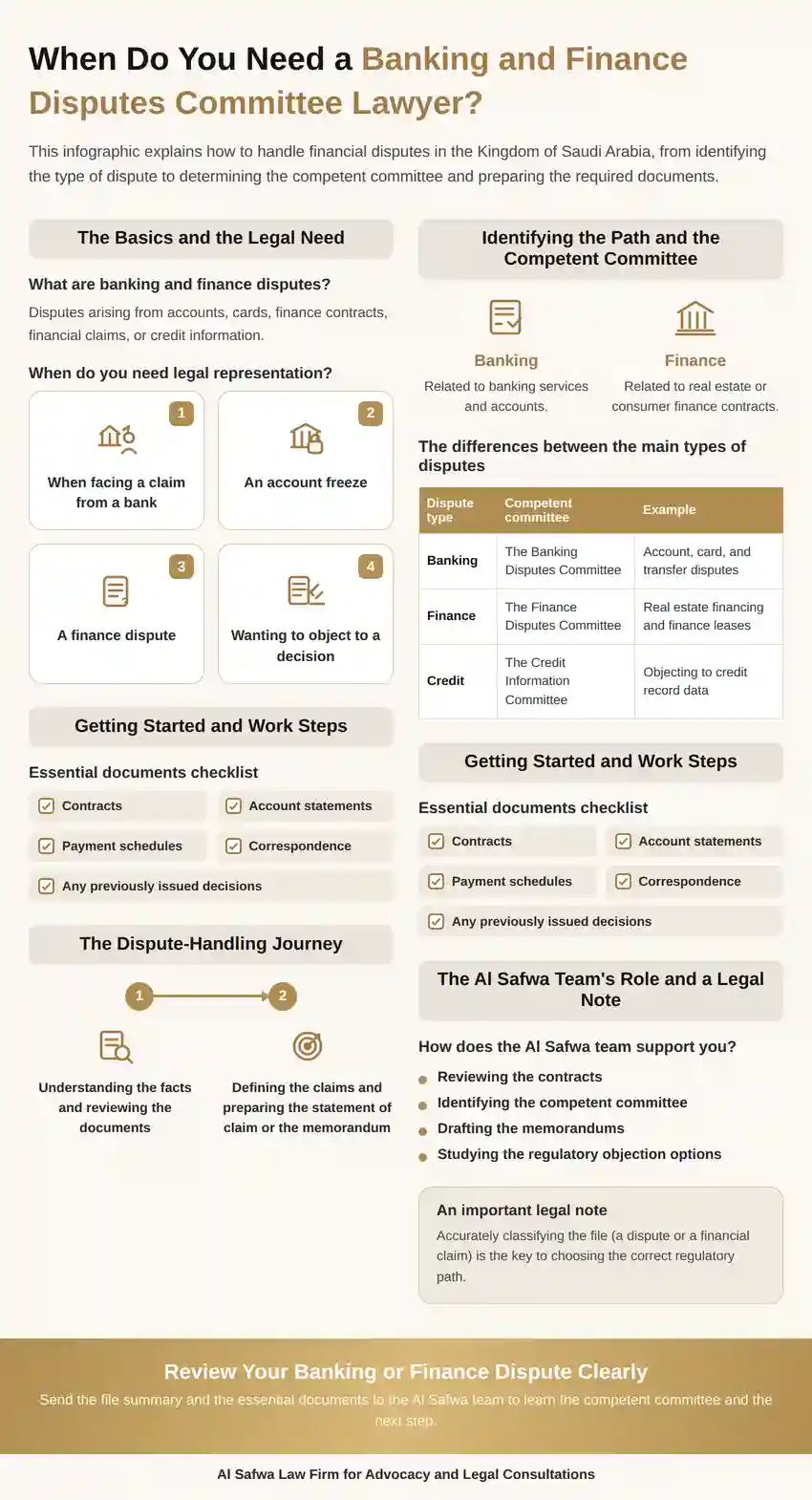
Which Committee Has Jurisdiction Over the Banking or Finance Dispute?
There is more than one competent committee, and jurisdiction is determined by the nature of the contract, the financial institution, and the submitted claims, not by the name of the bank or the finance company alone.
The Committee for Banking Disputes and Violations
It reviews disputes related to banking business and services within its jurisdiction, such as some disputes concerning current accounts, credit cards, transfers, banking transactions, account freezes, and some financing products offered by banks.
The Committee for the Resolution of Finance Violations and Disputes
It reviews disputes arising from the application of the finance laws and the contracts within its jurisdiction, which may include real estate financing, consumer financing, finance lease disputes, and claims related to finance companies.
The Committee for Reviewing Violations of the Credit Information Law
The committee reviews disputes and violations related to credit information within its jurisdiction. For the case to be accepted, a prior objection must have been submitted to the credit information company on the same subject, with proof of submitting the objection and its rejection or the outcome of its processing attached.
That is why the Al Safwa team starts by reviewing the contract, the service provider, and the claims before identifying the competent committee.
For details on the jurisdictions, you can read the article on the jurisdictions of the banking and finance disputes and violations committees.
How Does the Al Safwa Team Help You in the Banking or Finance Dispute?
The Al Safwa team handles the dispute according to its stage, starting from the initial review through to preparing the case, the reply, or the objection, within the agreed scope of work.
The services that can be provided include:
- Reviewing banking and finance contracts and their annexes.
- Reviewing account statements, payment schedules, and claims.
- Analyzing the correspondence exchanged with the bank or the finance company.
- Identifying the competent committee before submitting the application.
- Assessing the possible claims and defenses according to the documents.
- Preparing the statement of claim before the competent committee.
- Preparing the reply memorandum to the bank’s or finance company’s claim.
- Preparing the memorandums and procedural applications related to the file.
- Representing the client before the committee according to the type of dispute and the agreement.
- Studying the issued decision and identifying the objection options.
- Reviewing the enforcement procedures related to the decision.
- Exploring conciliation or settlement if it serves the client’s interest.
If what you need is only an independent statement of claim or memorandum, you can also review the pleadings and lawsuit drafting service.
If the Committee Has Issued a Decision, When Do You Need to Study the Objection?
A decision is not assessed by its final outcome alone; its reasoning, the claims that were reviewed, the defenses that were submitted, the documents the committee relied on, and the date the decision was notified must all be reviewed.
The objection-stage review may include:
- Reading the decision and identifying its operative part and its effects.
- Reviewing the reasons for accepting or rejecting the claims.
- Determining whether the defenses and documents were presented sufficiently.
- Spotting errors in applying the law or characterizing the relationship.
- Reviewing jurisdiction, standing, or the claims.
- Identifying the documents that may support the objection.
- Preparing the objection memorandum when suitable grounds exist.
- Studying the effect of the objection on the enforcement procedures.
Whether an objection is possible, and what effect it may have, cannot be determined before reviewing the type of decision, the committee that issued it, the notification date, and the procedure applied to the file.
What Documents Are Needed to Review the Dispute?
The documents differ according to the type of case, but preparing the file in an organized way helps identify the jurisdiction and the claims and assess the position more accurately.
Prepare whichever of the following documents are available:
- The banking or finance contract and its annexes.
- The account statement or the payment schedule.
- The claim or default notices.
- The correspondence with the bank or the finance company.
- The prior complaint and the reply issued to it, if any.
- The notices or decisions related to the account or the financing.
- The statement of claim or the other party’s memorandum if the case is ongoing.
- The decision issued by the committee and the notification date if the file is at the objection stage.
- Proof of the payment, transfer, or deduction in dispute.
- The power of attorney or the legal representative’s details if the client is a company or an establishment.
In credit information disputes, proof of submitting a prior objection to the credit information company, and the outcome of the objection, must be attached.
The committee may request a different form or attachments depending on the subject of the dispute, so it should not be assumed that the documents required in a credit card dispute are the same as those required in real estate financing or an account freeze.
The Steps of Handling the Banking or Finance Dispute
Handling a banking or finance dispute goes through several organized stages aimed at understanding the file precisely and identifying the suitable legal path before taking any action.
1. Receiving the Dispute Summary
The client explains the name of the financial institution, the type of contract or service, the value of the claim, and the stage the file has reached.
2. Reviewing the Documents
The contracts, account statements, payment schedules, correspondence, claims, and issued decisions are reviewed.
3. Identifying the Type of Dispute and the Jurisdiction
It is determined whether the dispute is a banking dispute, a finance dispute, or one related to credit information, and whether it needs a complaint, a settlement, or a case.
4. Defining the Scope of Work and the Fees
The client is told whether the required service is a consultation, a document review, preparing a statement of claim, a reply memorandum, an objection, or full representation.
5. Preparing the File and Following Up on the Procedure
After the agreement, the facts, documents, and claims are organized, the statement or memorandum is prepared, and the hearings, applications, and decision are followed up according to the scope of the service.
The Scope of the Service and How the Fees Are Determined
The service starts with a consultation or an initial review of the essential documents to identify the type of dispute, the stage of the file, and the competent committee.
After the review, the scope of work is defined clearly, and it may be one of the following options:
- A legal consultation on the position and the suitable path.
- Reviewing a contract, a claim, or a decision.
- Preparing a statement of claim.
- Preparing a reply memorandum.
- Preparing an objection memorandum.
- Full representation and follow-up before the committee.
- Negotiation or settlement according to the nature of the file.
The fees are determined by the type of dispute, the volume of documents, the value of the claim, the stage of the case, and the required work, and the scope of the service and the cost are clarified before starting, without promises of a specific outcome.
Do you have a contract, a claim, or an issued decision?
Sending the essential documents from the start helps identify the committee, the stage, and the suitable service, instead of entering a procedure that does not fit the type of dispute.
Can the Banking Dispute Be Resolved Amicably Before the Committee?
Conciliation or negotiation may be suitable in some banking and finance disputes, especially if the disagreement concerns amounts, a payment schedule, or obligations that can be agreed on.
However, accepting a settlement requires assessing:
- The actual value of the claim.
- The available documents.
- The rights each party will waive.
- The effect of the settlement on enforcement or the credit record.
- The new obligations and the payment dates.
- Whether the settlement ends the dispute entirely.
Choosing a settlement does not mean the position is weak, just as filing a case does not mean it is the best option in every file; the path is chosen after comparing the effect of each option on the client.
A Banking Disputes Lawyer for Individuals and Companies
The way the dispute is reviewed differs according to the client’s capacity and the nature of the financial dealing.
If the Client Is an Individual
The dispute may relate to a current account, a credit card, personal financing, real estate financing, a finance lease, or credit information.
The focus is usually on the contract, the amounts paid, the claim, the account statement, the correspondence, and the damage resulting from the procedure in dispute.
If the Client Is a Company or an Establishment
The dispute may relate to commercial financing, credit facilities, bank accounts, guarantees, finance contracts, or claims affecting the business.
Here, the review may require a broader study of the contracts, the capacity of the company’s representative, the guarantees, the defenses, and the financial and commercial effects. When needed, you can also visit the corporate lawyer page.
Why Does the Al Safwa Service Start With a File Review?
Identifying the path in banking and finance disputes does not depend on the description of the problem alone, but on the nature of the contract, the financial institution, the available documents, the submitted claims, and the stage the dispute has reached.
That is why the Al Safwa team starts with an initial review that helps to:
- Determine whether the dispute is a banking dispute, a finance dispute, or one related to credit information.
- Find out whether the file needs a complaint, a settlement, a case, or an objection.
- Review the contract, the account statements, the claim, and the issued decision.
- Identify the missing documents before submitting the application.
- Clarify the scope of the service and the fees before starting.
- Manage the file through a legal team instead of relying on individual judgment.
- Explain the available options without promising a specific outcome.
Al Safwa Law Firm’s office is located in Jeddah, and client files from all regions of the Kingdom can be reviewed depending on the type of dispute and the agreed scope of the service.
Is This Page the Right Service for Your Situation?
The suitable service is determined by the stage the dispute has reached:
- If you are at the stage of reviewing a bank contract, submitting an internal complaint, rescheduling, or settling a debt before a case is filed, the Banking and Finance Lawyer in Saudi Arabia page may be closer to your situation.
- If the dispute has turned into a case before one of the committees, you have received a statement of claim or a memorandum, or a decision has been issued that needs a reply or an objection, this page is the most suitable service.
- If the financial claim is between two companies or commercial parties and is not related to a banking or finance activity, the debt collection lawyer service may be closer to the dispute.
- If the disagreement concerns the drafting or interpretation of a general commercial contract, the contracts lawyer service is the suitable path.
Classifying the file before starting the procedure helps identify the committee, the service, and the required documents, and avoid entering a path that does not fit the nature of the dispute.
Frequently Asked Questions About the Banking and Finance Disputes Committee
What is the difference between the Banking Disputes Committee and the Finance Disputes Committee?
The Banking Disputes Committee reviews disputes related to banking services and business, while the Committee for the Resolution of Finance Violations and Disputes has jurisdiction over disputes related to finance contracts and finance companies, according to the nature of the file.
When do I need a Banking Disputes Committee lawyer?
You need a Banking Disputes Committee lawyer when you have a dispute with a bank over an account, a card, a transfer, a claim, an account freeze, or a decision that needs a reply, a case, or an objection.
Does the Finance Disputes Committee review real estate financing?
Yes, real estate financing disputes may fall within the jurisdiction of the Committee for the Resolution of Finance Violations and Disputes, according to the nature of the contract, the parties, and the submitted claims.
What documents are required to file a banking or finance case?
You usually need the contract, the account statements, the payment schedule, the correspondence with the financial institution, the notices, and any previous decision or reply, in addition to proof of your capacity or legal representation.
Can a decision of the Banking or Finance Disputes Committee be objected to?
An objection may be available in some situations, according to the applicable period and regulatory procedure. The decision, its reasoning, and the notification date must therefore be studied before determining whether an objection is possible.
Can the dispute be settled instead of filing a case?
Yes, a settlement may be suitable in some files, but its terms, its effects, and the rights the client would waive must be reviewed before it is adopted.
Do I need a lawyer in cases involving banks and finance companies?
You may not need full representation in every situation, but having a lawyer helps when there are large claims, complex documents, an issued decision, or a need to draft a case, a reply memorandum, or an objection.
Must a complaint be submitted before filing the case?
Some types of files may require a prior complaint or objection, depending on the nature of the dispute and the competent committee. In credit information cases, proof of submitting a prior objection to the credit information company must be provided, with the outcome or rejection of the objection attached.
Does an objection automatically suspend enforcement?
It should not be assumed that submitting an objection automatically suspends enforcement in every situation. The decision and the applied procedure must be reviewed to determine whether the file needs a separate application related to enforcement.
Does the firm handle committee cases outside Jeddah?
Al Safwa Law Firm's office is located in Jeddah, and files from other regions of the Kingdom can be reviewed and represented, depending on the type of dispute, the feasibility of providing the service, and the agreement with the client.
How are a banking disputes lawyer's fees determined?
The fees are determined after identifying the type of dispute, the volume of documents, the value of the claim, the stage of the case, and whether the service is a consultation, drafting, an objection, or full representation.
Summary
A banking or finance dispute first requires identifying the type of relationship and the competent committee, then reviewing the contract, the claim, and the correspondence before choosing the path of a complaint, a settlement, a case, or an objection.
At Al Safwa Law Firm, the team reviews the documents and explains the options and the scope of the service clearly, without unrealistic promises or the assumption that a single path suits all files.
Legal disclaimer: the information on this page is for general awareness purposes and does not constitute tailored legal advice. Procedures and jurisdictions differ according to the type of dispute, the documents, and the stage the file has reached.